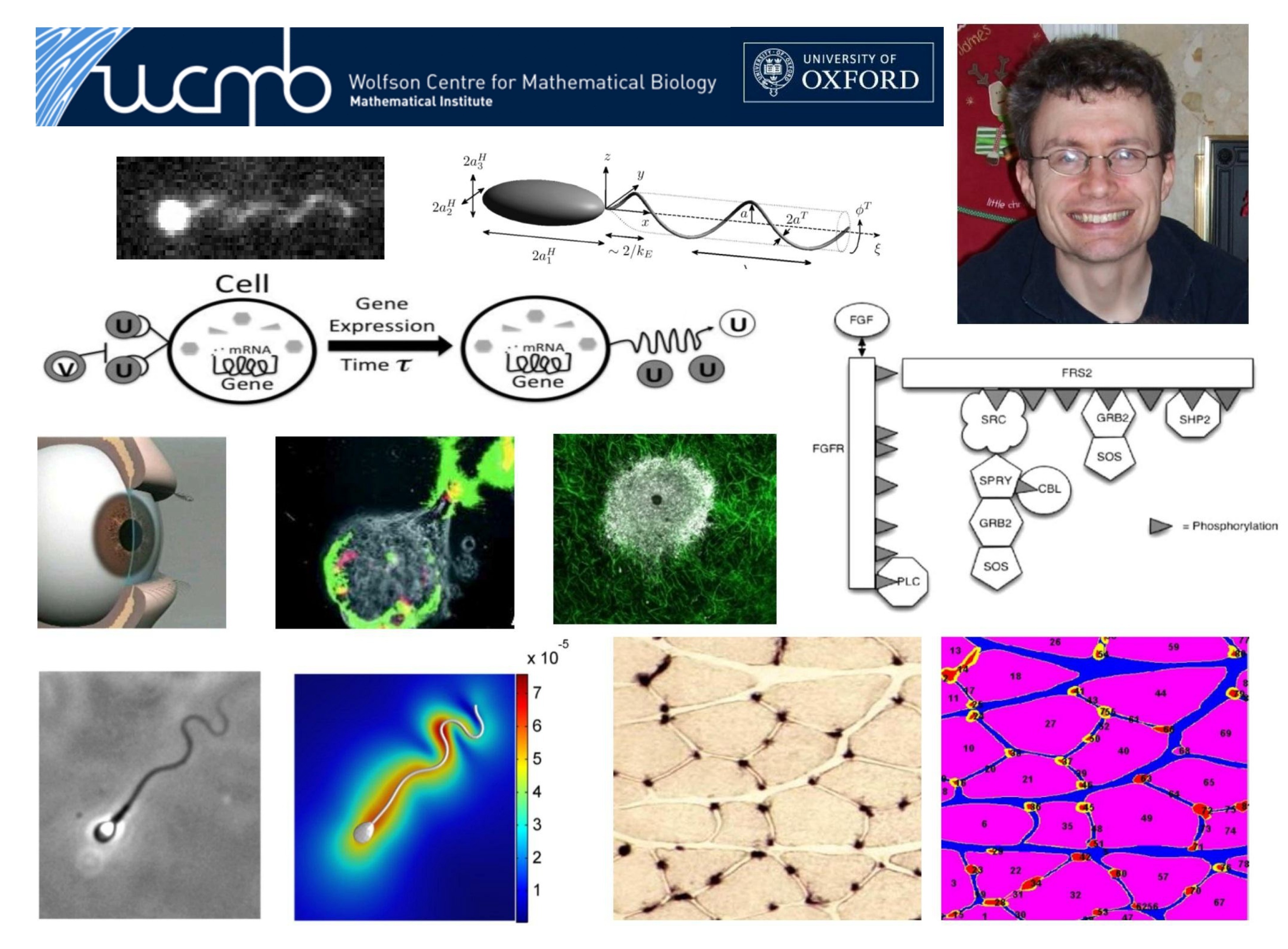
Eamonn A. Gaffney's Homepage

Background

I studied mathematics at The University of Cambridge, prior to a PhD in Mathematical Physics, followed by a Wellcome Trust Post-Doctoral Training Fellowship in Mathematical Biology at The University of Oxford. I proceeded to become a faculty member at The School of Mathematics, University of Birmingham for several years with duties ranging from lecturing to admissions tutor, in addition to research. In 2006 I returned to Oxford University to take up a faculty position in the Mathematical Institute.

Research

My research is primarily in the general area of biological and biomedical applications of mathematics. Topics I am actively pursuing include: 

Microbiological fluid dynamics including muco-ciliary dynamics and spermatozoa dynamics.

Mathematical and biological aspects of reaction diffusion systems. These range from mathematically based stability studies and to modelling transport phenomena on biologically realistic domains, captured by imaging.

Pattern formation mechanisms especially on growing domains and involving time delays.

Ocular surface fluid dynamics and solute transport

Models of cell movement, signalling and interaction.

Modelling tumours and chemotherapy scheduling 

In collaboration with many others (see my publication list below for details) my work has, for example, investigated the mechanics of how human spermatozoa accumulate at boundaries, showing that specialised 3D flagellar beating is not required for sperm to approach and stay near surfaces. As another example, the dynamics of the ocular surface fluid has been explored for different dry eye aetiologies, generating predictions for how damaging levels of corneal surface osmolarity, which cannot be readily measured, may be inferred from standard tear film diagnostics. Gene expression time delays have been shown to significantly influence reaction diffusion based biological models of pattern formation and arguably should not be neglected a-priori without justification as their inclusion can induce an extreme delay to patterning, or no patterning whatsoever. As a final example, the modelling of mucociliary flows reveals that empirical observations of microbead transport in in-vitro models of mucociliary flows need not correlate to the intuitively reasonable flow profile suggested by experimental scientists, due to the effects of diffusion perpendicular to substrate.


Projects

I am keen to hear from well-qualified, prospective, DPhil students and have a number of projects in the above areas which I am enthusiastic to develop. Similarly for self-funding post-docs or academic visitors. However formal applications for DPhils must follow the guidelines indicated in

http://www.maths.ox.ac.uk/cmb/AboutCMB/programmes.html


Recent Publications

[27] S Seirin Lee, EA Gaffney, NAM Monk, The Influence of Gene Expression Time Delays on Gierer-Meinhardt Pattern Formation Systems, Bulletin of Mathematical Biology, Submitted.

[26] P Moreo, EA Gaffney, JM Garcia-Anzar, M Doblare, On the modelling of biological patterns with mechanochemical models: insights from analysis and computation, Bulletin of Mathematical Biology, Submitted.

[25] DJ Smith, EA Gaffney, JR Blake, Mathematical modelling of cilia-driven transport of biological fluids, Proceedings of the Royal Society A (2009), doi:10.1098/rspa.2009.0018

[24] A Madzvamuse, EA Gaffney, PK Maini, Stability analysis of reaction-diffusion systems with time-dependent coefficients on growing domains, Journal Of Mathematical Biology, Submitted.

[23] EA Gaffney, JM Tiffany, N Yokoi, AJ Bron, A Mass and Solute Balance Model for Tear Volume and Osmolarity in The Normal And The Dry Eye, Progress in Retinal And Eye Research (2009), In Press.

[22] AJ Bron, N Yokoi, EA Gaffney, JM Tiffany, Predicted Phenotypes of Dry Eye - Proposed Consequences of its Natural History, The Ocular Surface (2009) 7, p78-92.

[21] DJ Smith, EA Gaffney, H Gadelha, N Kapur, JC Kirkman-Brown, Bend propagation in the flagella of migrating human sperm, and its modulation by viscosity, Cell Motility & The Cytoskeleton (2009), DOI: 10.1002/cm.20345.

[20] DJ Smith, EA Gaffney, JR Blake, JC Kirkman-Brown, Human sperm accumulation near surfaces: a simulation study, J. Fluid Mechanics (2009), 621, p289-320.

[19] HC Monro, EA Gaffney, Modelling chemotherapy resistance in palliation and failed cure, J. Theoretical Biology (2009), 257, p292-302.

[18] DJ Smith, EA Gaffney, JR Blake, Modelling mucociliary clearance, Respiratory Physiology & Neurobiology (2008) 163, p178-188.

[17] RE Baker, EA Gaffney, PK Maini, Partial differential equations for self-organization in cellular and developmental biology, Nonlinearity (2008), 21, R251-290.

[16] DJ Smith, JR Blake, EA Gaffney, Fluid mechanics of nodal flow due to embryonic primary cilia, Journal of The Royal Society Interface (2008) 5, p567-573

[15] EA Gaffney, JK Heath, MZ Kwiatkowska, A Mass Action Model of a Fibroblast Growth Factor Signaling Pathway and Its Simplification, Bulletin of Mathematical Biology (2008) 68, p99-130.

[14] DJ Smith, EA Gaffney, JR Blake, Discrete cilia modelling with singularity distributions, Bulletin of Mathematical Biology (2007) 69, p1477-1510.

[13] DJ Smith, EA Gaffney, JR. Blake, A model of tracer transport in airway surface liquid, Bulletin of Mathematical Biology (2007) 69, p817-836.

[12] DJ Smith, EA Gaffney and JR Blake, A visco-elastic traction layer model of muco-ciliary transport, Bulletin Mathematical Biology, (2007) 69, p289-327.

[11] M Kwiatkowska, G Norman, D Parker, O Tymchyshyn, JK Heath, EA Gaffney, Simulation And Verification For Computational Modelling Of Signalling Pathways, Proceedings of the 2006 Winter Simulation Conference, L. F. Perrone, F. P. Wieland, J. Liu, B. G. Lawson, D. M. Nicol, and R. M. Fujimoto, eds, (2006).

[10] EA Gaffney, NAM Monk, Gene Expression Time Delays and Turing Pattern Formation Systems, Bulletin Mathematical Biology (2006), p99-130.

[9] EA Gaffney, The Mathematical Modelling of Adjuvant Chemotherapy Scheduling: Incorporating the Effects of Protocol Rest Phases and Pharmacokinetics. Bulletin of Mathematical Biology (2005) 67, p563-611.  

[8] EA Gaffney, The Application Of Mathematical Modelling To Aspects Of Adjuvant Chemotherapy Scheduling, Journal of Mathematical Biology (2004) 48, p375-422.

[7] EA Gaffney, K. Pugh, PK Maini, F. Arnold, Investigating A Simple Model Of Wound Healing Angiogenesis, J. of Mathematical Biology (2003) 45 p337-374.

[6] E. Crampin, EA Gaffney, P.K. Maini, Mode Doubling And Tripling In Reation-Diffusion Patterns On Growing Domains: A Piecewise Linear Model, J. of Mathematical Biology (2002) 44 p107-128.

[5] EA. Gaffney, On Conditions For The Stability Of A Two Component Mixed Quasimonotone Reaction Diffusion Equation, J. of Mathematical Analysis and Applications (2001) 256, p513-524.

[4] JR Blake, EA Gaffney, Modelling aspects of tracer transport in muco-ciliary flows, In Cilia, Mucus and Mucociliary Interactions, 26, M Salathe (Editor), New York, Marcel Dekker, 291-302. (2001).

[3] EA Gaffney, PK Maini, JA Sherratt, S.Tuft, The Mathematical Modelling Of Cell Kinetics In Corneal Epithelial Wound Healing And Comparison With Experiment, Journal of Theoretical Biology (1999) 197, p15-40.

[2] EA Gaffney, PK Maini, C. McCaig, M. Zhao, J. Forrester, Modelling corneal epithelial wound closure in the presence of physiological electric fields via a moving boundary formalism, IMA Journal of Mathematics Applied in Medicine and Biology (1999) 16, p369-393.

[1] E. Crampin, EA Gaffney, PK Maini, Reaction and Diffusion on Growing Domains: Scenarios for Robust Pattern Formation, Bulletin Mathematical Biology (1999) 61, p1093-1120. 


Teaching

I am a tutorial fellow in Mathematical Biology at Brasenose College, Oxford, while details of my teaching commitments at The Mathematical Institute can be found at the following links for firstly Calculus Of One Variable, secondly Calculus Of Two or More Variables and finally Mathematical Ecology and Biology.